
Minimalism for Families with Busy Households
A busy family home can accumulate an astonishing amount of stuff without anyone intentionally bringing in “too much.” Minimalism for families offers a more realistic solution than striving for a perfectly tidy home: keep what your household genuinely uses, create simple places for those belongings, and reduce everything else so daily life becomes easier.

Minimalism for Families Should Make Daily Life Easier
Before decluttering a single drawer, pay attention to where your household regularly gets stuck.Where does everyone search for things? Which surfaces collect clutter almost immediately? What part of the morning routine feels unnecessarily complicated?
Perhaps shoes pile up beside the front door because there is nowhere convenient to put them. Maybe clean laundry stays in baskets because bedroom drawers are already full. Your kitchen counter might have become the unofficial home for school notices, receipts, keys, chargers, reusable bags, and everything else that enters the house.
These small frustrations are useful clues.
Instead of beginning with a random cupboard, start with the area that creates the most disruption. Improving one heavily used space can have a much bigger impact on family life than organizing several areas nobody interacts with regularly.
Professional home organizing services in Vancouver can also help identify these problem areas and create practical systems around the way your household actually functions. Organize by Flo works with kitchens, closets, children's rooms, laundry rooms, home offices, garages, and other spaces where clutter can interfere with daily routines.
Make Family Decluttering More Manageable by Working in Categories
Trying to declutter an entire house in one weekend sounds productive.
Usually, it is exhausting.
Instead, choose one category at a time. Gather every item in that category together so you can see exactly how much your family owns.
Start with something straightforward such as reusable water bottles, children's shoes, bath products, food containers, board games, coats, or school supplies.
This approach makes duplicates surprisingly easy to spot. If you discover 18 water bottles but your family regularly uses six, you can quickly identify favourites and let go of the ones nobody reaches for.
I find one question especially helpful here:
How many of these does our household realistically need?
It is much easier to answer than asking whether you should simply “get rid of more stuff.”
For homes that have accumulated belongings over many years, professional decluttering and downsizing services in Vancouver can provide hands on guidance with sorting, simplifying, and deciding what deserves space in your home.
Create Simple Home Organization Systems the Whole Family Can Use
An organization system should not require instructions.
If children cannot understand where something belongs or adults need several steps to put an everyday item away, the system will probably fall apart during a busy week.
Keep categories broad and obvious.
Instead of creating separate toy containers for cars, trucks, construction vehicles, and trains, one larger container labelled “Vehicles” may be far easier for a child to maintain. Frequently used toys can work well in open baskets because there is no lid to remove and no complicated sorting required.
Apply the same thinking throughout your home.
If handbags constantly end up on a dining chair, adding a convenient hook near the place where you naturally put them down may solve the problem. If children drop backpacks at the entrance every afternoon, create backpack storage there rather than expecting them to carry everything into another room.
Good organization works with behaviour instead of constantly trying to change it.
Reduce Household Clutter With the One Touch Habit
Many clutter problems begin with a simple phrase.
“I'll deal with that later.”
Mail gets placed on the counter. A jacket lands on a chair. A school form gets moved from the kitchen to the dining table and then onto a desk.
Every temporary location creates another task.
Whenever practical, try handling an item once. Recycle unwanted mail immediately. Put important paperwork into one designated action tray. Hang coats when you enter the house. Place keys in the same bowl or drawer every time.
Of course, no family will do this perfectly.
The purpose is simply to reduce the number of places where belongings stop before reaching their actual home.
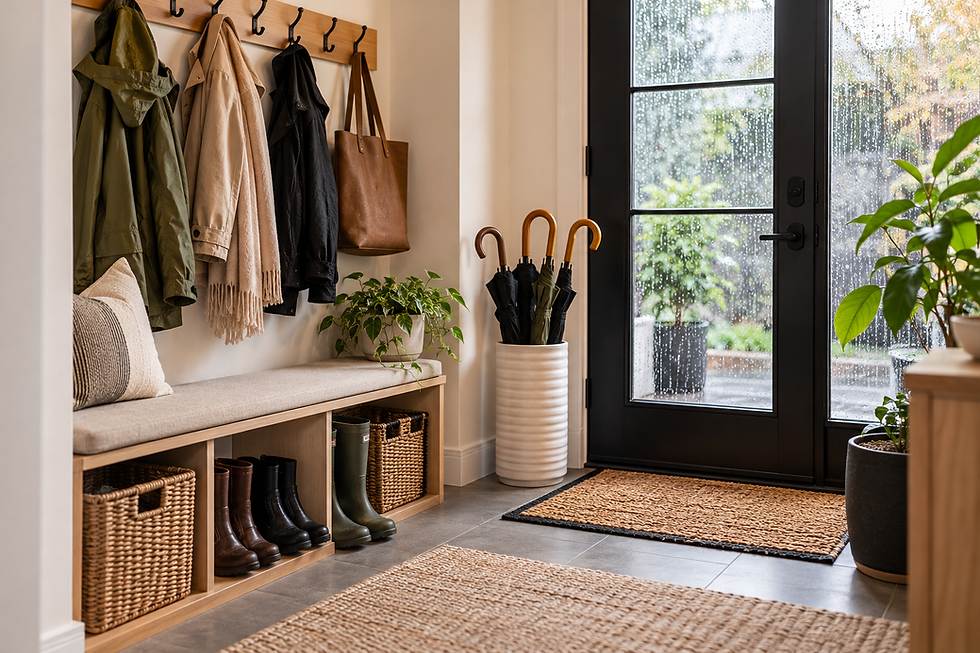
Minimalist Entryway Organization Can Transform Busy Mornings
The entryway is one of the best places to apply family minimalism because it affects both the beginning and end of the day.
Give each family member a reasonable amount of dedicated space. Depending on your home, this could include a hook for a jacket, another for a backpack, a shoe basket, and a small container for hats or gloves.
Avoid keeping every coat and pair of shoes your family owns near the front door.
Store only what is currently being worn regularly. Seasonal and occasional items can live elsewhere, leaving the entrance easier to navigate and making everyday belongings faster to find.
Another useful idea is an outgoing basket.
Use it for library books, store returns, school items, packages, or anything that needs to leave the house soon. Instead of those objects moving between countertops and tables, everyone knows where to find them on the way out.
Just remember to empty it regularly!
Use Family Minimalism to Simplify Children's Toys
Toy organization can be difficult because children form genuine attachments to their belongings. Rather than removing toys without their involvement, make decluttering a gradual and age appropriate process.
Begin with the easiest decisions.
Broken toys can go. Incomplete sets that are no longer usable can go too. Then identify toys that have been outgrown or haven't attracted attention for a long time.
For everything that remains, consider toy rotation.
Keep a manageable selection available and store another group out of sight. Every few weeks or months, rotate the selection. Children have fewer items to sort through, cleanup becomes faster, and previously stored toys often feel interesting again when they return.
Physical boundaries also help.
If stuffed animals belong in one basket, that basket determines how many comfortably fit. When it becomes overcrowded, choose favourites together rather than automatically introducing another storage container.
Sometimes the answer to clutter is not more storage.
It is less inventory.
Minimalist Kitchen Organization Saves Time Every Day
A busy family kitchen can easily become overcrowded because almost every object seems useful.
The problem is that too many useful things can make the things you use every day harder to reach.
Start with your family's routines.
If mornings are hectic, create a breakfast area where cereals, oats, spreads, and other everyday foods are grouped together. Keep lunch containers, reusable bags, and water bottles close to one another so preparing school and work lunches requires fewer trips around the kitchen.
Then look at food storage containers.
Match containers with their lids. Remove damaged pieces and containers without partners. Nest similar sizes together and store lids vertically where you can see them rather than stacking them underneath everything else.
Next, inspect your everyday cooking tools. If one drawer contains five spatulas but you consistently use the same two, you probably already know which ones deserve the easiest access.
Small improvements add up quickly.
Stop Clutter Before It Enters Your Family Home
Decluttering is important, but controlling what enters your home can save even more time.
Before buying something that is not essential, ask yourself one practical question:
Where will this live?
Suddenly, the purchase becomes more than a decision at the checkout. You are also considering where the item will be stored, how often it will be used, what it may replace, and whether your household genuinely has room for it.
This can be particularly helpful with children's belongings.
For birthdays and holidays, consider suggesting experiences, activities, lessons, memberships, or contributions toward one meaningful larger gift when relatives ask what your children would like.
You can also keep a donation container in a convenient location at home. When someone finds clothing that no longer fits or an item they no longer need, there is immediately somewhere for it to go.
Once the container is full, deal with it. Do not let it become permanent storage.
Try a 10 Minute Family Reset for an Organized Home
You do not need to spend your weekends constantly reorganizing the house.
A short evening reset can be far more effective.
Set a timer for ten minutes and have everyone return belongings to their homes. Shoes go back to the entrance area, toys return to their baskets, dishes move into the kitchen, paperwork goes into the appropriate tray, and anything that belongs upstairs gets taken with you.
Children can participate too, with responsibilities suited to their age.
The aim is not to make the home perfect every evening. It is to prevent small amounts of daily clutter from accumulating into a much larger project.
Ten minutes is manageable.
More importantly, tomorrow morning feels better.
Use the One In, One Out Rule Where Your Family Needs It Most
The popular one in, one out rule can be useful, but applying it rigidly to every possession is unnecessary.
Instead, use it for categories that tend to grow without anyone noticing.
Clothing is a good example. If three new shirts enter a drawer that is already comfortably full, identify three outgrown, uncomfortable, or rarely worn pieces that can leave.
The same approach works for toys, books, mugs, shoes, beauty products, and reusable bottles.
Storage has limits.
When a drawer or cupboard becomes difficult to use, resist the immediate temptation to buy another organizer. Look at the contents first and ask whether everything still deserves its place.
Often, the simplest storage solution is having less to store.
Professional Home Organization for Busy Vancouver Families
Family minimalism should reduce the amount of work required to run your home, not create another set of rules you have to maintain.
The best organization systems are usually the ones you barely notice. Children know where backpacks belong. You can find the scissors immediately. Putting away groceries does not require rearranging the pantry first. Clean laundry actually fits inside the drawers.
That is what functional organization looks like.
If your household has accumulated more than you can comfortably manage, Organize by Flo can help you sort belongings, declutter problem areas, and create practical systems tailored to your family's routines. Services are available throughout Vancouver and the Lower Mainland, while virtual home organization services provide another option for people who prefer professional guidance remotely.
Create a Simpler Home That Works for Your Family
Minimalism does not require your family to live with as little as possible. A more realistic goal is to keep what you genuinely use, enjoy, and have room to manage comfortably.
Start with the area that frustrates you most. Simplify it, give the essentials logical homes, and live with the new system for a while before moving on to the next space. Those thoughtful changes can gradually create a home that feels easier to use and considerably easier to maintain.
If clutter is taking more of your time and attention than you would like, professional support can make the process much more manageable. Organize by Flo offers personalized home organizing and decluttering services designed around real households and real routines.
Ready to create a calmer, more functional home for your family? Contact Organize by Flo today to book a consultation and start building an organized space that is easier to live in every day.


Comments